Daikon is the japanese name for the big white radish. It is called 白萝卜 "bai luo bo" in mandarin hanyu pinyin, and "lo bak" in Cantonese.
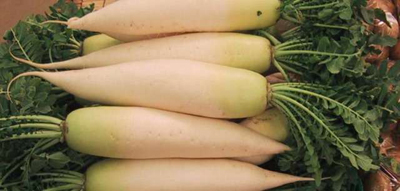
Photo source: Chris 73 at wikimedia.org
It is a tuber that looks like the carrot, except it is whitish in colour. In fact, the carrot is known as "hong luo bo" which means "red radish".
It contains glucose, cane sugar, fructose, dietary fibre, vitamin C, amino acids, and potassium.
Traditional chinese medicine practitioners believe that the it can help to clear phlegm, stabilize the breath, and is cooling. Children suffering from colds with dry painful throats and rackling cough are encouraged to eat it raw although I do not think they will like the taste. It also promotes the absorption of calcium.
It contains digestive enzymes such as diastase and amylase that can help break down starch into sugars. It therefore aids digestion and improve metabolism.
It is also affectionately acknowledged as the little ginseng. A Chinese folk saying "冬吃萝卜夏吃姜,不劳医生&# 24320;药方" which means "Radish in the winter, ginger in the summer, and the doctor's out of business." alluded to its efficacy in dietary therapy, especially during the winter months.
People with stomach ulcers or chronic gastric problems do have to be careful not to consume too much daikon. People on medication or taking tonics are also advised to avoid daikon as it might affect the efficacy of the medications.
Different parts of the radish can taste different. The top part is supposed to be sweeter so it is suitable for grating or used in salads. The tip is spicy and is usually pickled. The middle section contains the most liquid and is commonly used in stews.
Although daikon can be quite spicy, that hasn't stopped people from using it raw in salads. It just has to be "treated" first. In that I mean pickled.
The Japanese likes to pickle the daikon. One of the most distinctive pickled products is the yellow pickled slices that are almost always served in Japanese bentos. But cutting them into long thin strips and marinating them in some salt and vinegar is a common way of doing a quick starter.
It is also hugely popular grated and marinated with salt and left to stand for a while to reduce its "bite". The grated daikon in a small dish of soy sauce makes a great dipping sauce.
It can be cut into chunks and cooked in soups or stew. After sufficient simmering, it loses its spicy taste and takes on the flavour of the soup or stew it is cooked in. It is popular in stews featuring beef, lamb or mutton.
I personally like the white radish in stews where they are simmered to juicy softness and full of the flavour of the dish. It is also indispensable in the tempura dipping sauce. The grated radish imparts a certain depth to the thin sauce.
I almost forgot to mention this, perhaps because this dish has nothing to do with soup. The big white radish is the ingredient in a very popular street food in Singapore: the fried carrot cake. The radish is shredded, mixed with rice flour and steamed into big cakes. These cakes are then diced into small cubes before being fried in a big wok with eggs and with or without sweet black sauce. Click on the hyperlink just above to see 2 recipes.

Photo source: LaRuth at Flickr
Pick radishes that have nice white, plump and shiny skin. Leaves should be green and plump. Avoid those with shrivelled leaves.
If you are going to keep the daikon for a while, remove the leaves and wrap the cut portion with cling wrap. Wrap the entire radish with newspaper and store in the refrigerator.
How to prepare
The skin can be eaten so wash and scrub thoroughly before cooking. If you want to remove the skin, do so with a peeler like you would with a carrot. However nearly 98% of the calcium in daikon can be found in the skin.
It can be sliced, diced, shredded and grated. It is also a great subject for decorative food carving.
If using raw, wash thoroughly, cut, slice or shred and let it stand in salt.
Recipe list
- 2 stew beef recipes with daikon
- Daikon radish salad
- Singaporean fried carrot cake
Search within this site:


