In Chinese cuisine, bean sprouts generally refers to either the mung bean or the soybean sprouts. The latter is bigger. Not rocket science since the soybean is much larger. See pictures below.
Bean sprouts are more nutritious than the beans. Apparently, vitamin C, asparagine and other nutrients in the beans increased dramatically when they start to sprout.
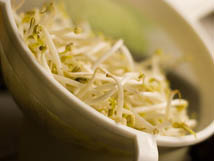
Mung bean sprout. Photo source: Stefan Eberlein at wikimedia
Soybean sprouts. Photo source: karendotcom127 at Wikimedia
Sprouts are known to be low in calories but high in vitamins, minerals and soluble fibre. The proteins in sprouts are also more easily digestible than the ones found in beans. They are very nutritious food and great as dietary supplement for heart protection, oral ulcers, constipation and colon cancer prevention.
They are sold with or without their straggly roots. Those that still have their roots keep better. Rootless ones are best used on the day they were bought.
The roots can be eaten but my family prefers to remove the roots first. Removing the roots, sprout by sprout might seem like a big chore. If you have children around, you can get them to help. I remember competing with my siblings over who can pinch the roots the fastest. Now that I am older, I suspect that the competition was my grandmother's ploy to get us to help her since it can be quite boring if you are pinching roots alone. Some of you may be thinking why pinch by hand when you can cut them off with a knife. Trust me, it is better to pinch by hand.
How to grow bean sprouts
Grow your own sprouts. It is quite easy:
- Take a bunch of mung beans and wash them
- Soak them in some water and remove any that floats
- Soak the rest in room temperature water overnight or until you can see splits in the beans
- Get a flat shallow tray and lay a thin layer of cotton wool or muslin cloth over it
- Spread the split beans evenly over the cotton wool or muslin cloth, make sure that none of the beans overlap
- They should start sprouting and growing tall
- Harvest them when they are about 2 inch high
- Remove the roots before use (optional)
How to eat bean sprouts
These sprouts are quite versatile. They have been used in salads, wraps, soups, fried noodles and rice or stir-fried together with other vegetables. The Koreans like to pickle the korean bean sprouts and it makes a great appetizer.
They can be eaten raw but can be quite spicy. The Vietnamese uses raw sprouts in their rice paper rolls. I always dipped the rolls in thick sweet sauce to mask the spiciness. Yes, I prefer my beansprouts well cooked with the bite and edge cooked out.
In my humble opinion, the easiet way to use them is to add them to a pot of hot clear chinese soup. They are great in quick soups or noodle soups.
Do not add to soups meant for long simmering. They cook quickly so they should be blanched and dunked into cold water or quick-fried to retain their crunchy texture.
Choose those with firm and white stems. Avoid those with spots. If you are keeping them for a while, air them for a while, then wrap them in used newspapers to keep them dry. If they are wet, they turn mushy quickly.
They are quite easy to clean. Remove the roots before soaking and washing. Some people even remove the heads but I find that too tedious and the heads are visually quite pleasing.
Recipes
Try some of these bean sprout recipes.
Search within this site:


