Benefits of Astragalus Root (黄芪 huang qi) in chinese cooking
Astragalus root 黄芪 (huang qi) is highly regarded as a general tonic especially for people who are feeling a little under the weather.
Known scientifically as radix astragali, it is the root portion of astragalus membranaceus or astragalus propinquus. This plant is from the pea family and is grown in Northeast China, North China, Inner Mongolia and Xinjiang.
The root is long, cylindrical and yellow-brownish in colour. It can be mispelled as astragulus. The root is dried and sliced thinly. It has a mild licorice-like taste.
The benefits of astragalus is legendary in China. It helps to increase energy levels, build up resistance especially when your immune system is lowered by overworking and stress.
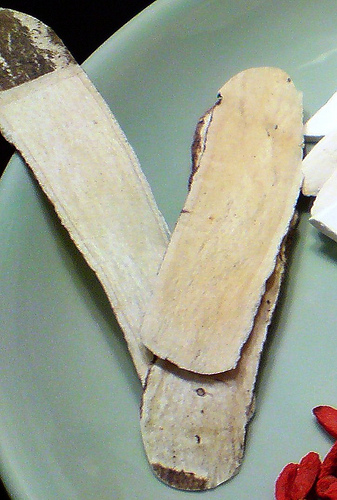
Scientific studies have revealed that natural substances in the root promotes blood circulation and stimulate the production of interferon. This protein regulates cell growth and works on the immune system.
Research has been and are being conducted on radix astragali to explore and learn about its effects on various types of diseases such as cancer and diabetes. It has been observed that the root does exhibit positive effects on viral infections, ulcers, liver protection, cancer, blood pressure and is diuretic.
Astragalus extracts and pill supplements are now quite common in the drug stores. People are paying and taking these processed supplements hoping that it would improve their health. But nothing beats preparing the real and natural thing in a chinese soup. Moreover, I believe it is also cheap in its natural dried form.
Radix astragali is commonly prepared in soups or tea. The root itself is not eaten. Only the tea or soup is consumed.
If you think you are coming down with a flu or cold, have sinus or ear infection, try some astragalus root tea before you pop some pills.
Recipe for astragalus tea
Reduce the amount of astragalus root to adjust the strength of the tea.
Ingredients-
10g dried astragalus root
1g red tea or 1 red tea bag
500 ml water
- Add the root to the water and bring to a boil
- Let it boil for about 5 minutes
- Remove the root from the water
- Place the tea bag in a cup and pour in the water
- Steep the tea bag for a couple of minutes
- Place in a thermo flask and sip it slowly throughout the day
Not for everyone
In traditional chinese medicine, Bei Qi is commonly recommended to many types of immune disorders caused by poor or low immune function. Because it stimulates your immune system, people with over-active immune systems such as patients with multiple sclerosis, lupus, rheumatiod arthritis should not consume it. The same goes for pregnant or nursing women.
What is the difference between 黄芪 (Huang qi) and 北芪 (Bei qi)?
You might have come across chinese herbal recipes listing 北芪 (Bei qi) as an ingredient. Bei qi is used to differentiate the astragalus root from Inner Mongolia. It is a slight variation and the quality is supposed to be better than those from other parts of China.
Because it is a root and isn't very palatable, it is almost always used in soups or tea, seldom in stir-fries or other types of cooking. I have paired it with fish, pork, various vegetables and chicken.
Dear visitors
If you want to re-post information on this page, ask me first or follow these instructions. I'm flattered that people think my written content is good enough to re-use but I think it is only polite to seek permission. Pictures appearing on this page are not necessarily mine. Click through to find the original flickr owner.
This page has been edited and updated on 19 June 2013.
Thanks, Phoebe
| Share on Facebook |
| Chinese Soups home / Chinese Herbs / Astragalus Root |