Cook Chinese Watercress Soup 3 Ways 西洋菜汤
Chinese watercress soup or 西洋菜汤 (xi yang cai tang) is not the same as watercress soup. Read on to know why.
The main ingredient in the Chinese watercress soup is the Chinese watercress. Unlike the watercress used in English creamy watercress soup which has thick roundish shiny leaves, this variety has long tender stems.
It is called 西洋菜 (xi yang cai) in Mandarin and it literally means "western vegetable". Along the stems are small outshoots with small oval leaves. The official Chinese name is 豆瓣菜 (dou ban cai). So, why in the world is it called western vegetable?

There are 2 stories about how the watercress came to be known as the "western vegetable" 西洋菜 (xi yang cai).
Version 1:
Around the 1930s, an overseas Chinese who migrated to Portugal returned to Guangzhou to visit his relatives. He brought some watercress seeds with him. He started growing them in Guangzhou and also gave some seeds to people in Macau and Hong Kong. It became very popular and because it came from a western country, it was called the "western vegetable".
Version 2:
Legend has it that a Portuguese sailor survived a serious illness, probably tuberculosis. He wasn't expected to survive but he did. He attributed his survival to the watercress that he ate during his illness. Years later, he relocated to Macau and brought the seeds to grow there. It become popular as it grows well and have health benefits. Since it was brought over from a western country by a western, the watercress was fondly called the "western vegetable".
What do you think? Which story sounds more plausible?
Benefits of Chinese Watercress
Regardless how the vegetable came to China, it now has a firm position in Asian cuisine. The Cantonese loved it. And so do a lot of people in Southeast Asia.
It is considered a superfood. It is supposed to have very high SOD levels which means it is high in anti-oxidants. It is believed to be cooling and good for the lungs. Watercress is also high in Vitamin C, vegetable protein, insoluble fibre, calcium, and potassium. It can be simmered until it is very soft, so it is good for old folks who need to consume more calcium to prevent osteoporosis.
According to traditional Chinese medicine, people who have a weak constituency may experience diarrhea when they eat watercress. To prevent this, add red dates, dried longan and ginger to make the dish warmer. Pregnant women should avoid this.
How to Prepare Watercress
Watercress is usually sold without the roots. But if yours came with them, cut them off first. They are also sold in bundles so they tend to clump together. Take a bit of time to separate them.
The stems are quite short so they seldom need to be cut further because once they are cooked down, they are very soft. But if you are serving this to old folks or children, cut them into shorter sections. Wash them well. Remove leaves or stems that have wilted.
Chinese watercress is rarely eaten raw in Asia. The fragrance of the vegetable really comes through when it is cooked well. It is quite distinct, nobody will mistake it for something else.
The Cantonese love to use it in soup. It can be paired with pork, chicken, duck and fish. Chinese herbs like red dates, dried longan and goji berries are frequently added to balance the cooling effect of the soup. They are usually simmered until mushy and dark.
Although rare, watercress can also be stir-fried and make into sweet watercress tea (see the last recipe). I first tried the sweet watercress tea at my ex-boss' home. It was Chinese New Year and he invited us to his home for a dinner. He mentioned it is a Cantonese recipe. :)
Recipe 1: Watercress soup recipe with red dates

This soup is a broth that has been simmered for a few hours to produce a really sweet soup. Chinese watercress, like the round cabbage, is better when really well-cooked. Or it could be my preference for really soft watercress in soup.
Ingredients
- 600g fresh Chinese watercress
- 300g fresh pork ribs
- 6 red dates
- 1 tbsp chinese wolfberries/goji berries
- Dash of salt
- About 1200ml water
Directions (Stove-top)
- Parboil the pork ribs
- Wash and clean the watercress
- Bring a pot of water to a boil
- Place the pork ribs, red dates, chinese wolfberries into the pot
- Add the watercress last and press it a little into the water. Don't worry if the watercress seems a lot, it will shrink.
- Lower the heat to a slow simmer and simmer the soup for about 4 hours (the simmering time depends on your preference for crunchy or mushy watercress)
- You know you are about there when you can smell the fragrance of the watercress in the air
- Give the soup an occasional stir
- Season with salt before serving
Directions (Slow cooker)
- Parboil the pork ribs
- Wash and clean the watercress
- Set up your slow cooker by turning it on cook and adding 1200ml boiling water
- Place the pork ribs, red dates, chinese wolfberries, watercress into the pot
- Cover and let the soup come to a boil
- If your slow cooker has a low setting, switch to low at this point. If not, just leave it. If the cover is dancing, leave a gap for steam to escape (you can use a spatula or long chopsticks)
- Cook the soup till the watercress is soft and you can smell the fragrance in the air
- Adjust the cooking time according to your preference for crunchy or mushy watercress.
- Season with salt before serving
Directions (Thermal pot)
- Parboil the pork ribs
- Wash and clean the watercress
- Place the inner pot of the thermal pot on the stove top and bring the water to a boil
- Add the pork ribs, red dates, chinese wolfberries and watercress
- Bring the soup back to a boil and continue to cook for about 20 minutes
- Bring the soup up to a roaring boil, cover the inner pot, remove from stove top and straight into the outer pot.
- Seal tightly and leave it for 4-5 hours.
- Before serving, bring the inner pot out and back on the stove top.
- Heat up the soup to a boil, season with salt to taste
- Serve.
Recipe 2: Watercress soup recipe with honey dates

This recipe contains sweet corn which makes the soup extra sweet.
Ingredients
- 2 ears sweet corn
- 1 pound watercress
- 4 honey dates
- A tablespoon goji berries
- 8 oz lean pork
- 1 piece dried tangerine peel
- 1 litre water
- Pinch of salt
Directions (Stove top)
- Wash the sweet corn and cut into sections
- Wash the watercress
- Wash the honey dates
- Soak the dried tangerine peel
- Parboil the lean pork
- Bring the water to a boil
- Place the sweet corn, watercress, honey dates, goji berries, lean pork and dried tangerine peel into the water
- Bring back to a boil
- Lower the heat to a simmer for 2.5 hour
- Season with salt
- Serve
Directions (Slow cooker)
- Wash the sweet corn and cut into sections
- Wash the watercress
- Wash the honey dates
- Soak the dried tangerine peel
- Set up your slow cooker by turning it on cook and adding 1 litre boiling water
- Place the lean pork, honey dates, sweet corn, tangerine peel, and watercress into the pot
- Cover and let the soup come to a boil
- If your slow cooker has a low setting, switch to low at this point. If not, just leave it. If the cover is dancing, leave a gap for steam to escape (you can use a spatula or long chopsticks)
- Cook the soup till the watercress is soft and you can smell the fragrance in the air
- Adjust the cooking time according to your preference for crunchy or mushy watercress.
- Season with salt before serving
Recipe 3: Herbal Watercress Tea with Buddha's fruit
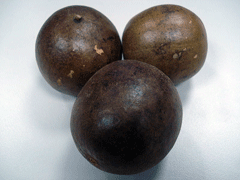
The Buddha's fruit or 罗汉果 (luo han guo) is a key ingredient in a popular Chinese herbal tea 凉茶 (liang cha) known for its cooling properties. It should be available in asian grocery stores in dried form.
This is a sweet soup, a sort of cooling herbal tea. It could be too cooling for some people. If you try this and happen to experience loose stools, it is probably too cool for you.
Ingredients
- 600g Chinese watercress
- 2 litres water
- 1/2 buddha's fruit
Directions (Slow cooker)
- Wash the watercress thoroughly
- Cut into shorter sections
- Bring the water to a boil in the slow cooker (make sure the slow cooker is able to handle 2 litres of liquid to prevent boil-over)
- Add the watercress and buddha's fruit and cook on high for 4 hours
- Strain the soup
- Sweeten with a little sugar or honey (although it shouldn't be necessary as the buddha's fruit is sweet)
- Serve
You can also store this in the refrigerator and enjoy it cold.
How to grow watercress?
600 Premium Organic Watercress Seeds by Happy Seeds & Garden
Happy Souping, Phoebe
Recent Updates
-
Daikon Radish Recipes from Pickle, Soup, Steam and Pan fried 白萝卜食谱
Oct 10, 21 10:44 AM

Learn how to use the daikon radish in a variety of Chinese daikon radish recipes from pickling, soup, braising, steaming, and pan-frying.
-
Find Bitter Melon Recipes From Soup, Stir Fry, Omelette and Chips 苦瓜食谱
Oct 08, 21 09:24 AM

What is Bitter Melon? Are they really bitter? How do you use bitter melon?
-
Simple Bean Sprout Recipes 豆芽食谱
Oct 04, 21 10:40 PM

Bean sprout recipes for soups, salads and stir-fry, wraps, rolls, omelettes, pancakes and more.


Copyright Statement
I am flattered that people think my content is good enough to re-use. Please follow the instructions on my copyright policy page on how you can repost or re-use. Please do not re-use until you have read my copyright notice.
Pictures appearing on this page are not necessarily mine. Click on the image to the original source.
There are affiliate links on this website. If you use the links to make purchases, I get paid a small amount for the sale - at no extra cost to you. I appreciate the support! [Amazon, Shopee]
Give


Homemade Chinese Soups by Phoebe Lim Choon Lan is licensed under a Creative Commons Attribution 4.0 International License.
Privacy Policy | Disclosure and Disclaimer
This site is powered by SBI and has been live since 2006